Best Time to Visit Vietnam: A Region-by-Region Weather Guide
It wasn’t until the week before my trip to Vietnam that I realized paying attention to the weather (read: the rainy season) is a very good idea. The best time to visit Vietnam should be one of the first questions you ask.
The short answer: it depends on the region. Vietnam is a long, narrow country stretching more than 1,600 kilometers (about 1,000 miles) from north to south, with mountains, deltas, coastlines and plateaus. The climate changes dramatically from one region to the next, so while Hanoi may be cold and drizzly, Phu Quoc can be enjoying perfect beach weather.
In this guide, I break down, region by region, when to go to Vietnam for the best weather, how to avoid heavy rain and typhoons, and how to catch festivals and unique landscapes like the golden rice terraces of Sapa or the canals of the Mekong Delta.
Before you keep reading:
What Is the Best Time to Visit Vietnam Overall?
If you want a quick answer, here is the rule of thumb:
- Spring (March to April): the best window for traveling the whole country from north to south in a single trip.
- Fall (September to November): excellent for the north and a good choice for central Vietnam until October, though the central coast can see rain.
- Winter (December to February): ideal for the south and the beaches, cold in the north.
- Summer (May to August): a good season for central Vietnam and the beaches of Da Nang and Nha Trang, but hot and humid in the north and rainy in the south.
Because no single month is perfect for the entire country, the smartest approach is to choose your route based on the time of year, not the other way around. Let’s look at each region.
How Vietnam’s Climate Works: Two Monsoons and Three Regions
To understand Vietnam’s seasons, it helps to know two factors:
- The northeast monsoon (October to April): brings cool, dry air to the north and rain to the central coast.
- The southwest monsoon (May to September): brings heat, humidity and rain to the north and south, and dry, sunny weather to much of the central coast.
As a result, for tourism purposes Vietnam is divided into three main zones: north, central and south, plus the Central Highlands plateau (Da Lat), which has its own microclimate.
Best Time to Visit Northern Vietnam (Hanoi, Sapa, Ha Long Bay, Ninh Binh, Ha Giang)
The north is the only part of the country with four clearly defined seasons. The temperature difference between winter and summer is significant.
Spring in the North (March to April)
This is one of the best times to visit. Temperatures are mild, between 18 and 27 °C (64–81 °F), the landscape is green and there are fewer storms. March can bring a fine drizzle and gray skies, the famous mưa phùn, but April is usually very pleasant. It’s a great time for Hanoi, Ninh Binh and Ha Long Bay.
Summer in the North (May to August)
It’s hot and very humid, with temperatures above 33–35 °C (91–95 °F) and heavy rain in July and August. This is also typhoon season, which peaks between July and September and can lead to cancelled cruises in Ha Long Bay.
On the upside:
- The rice fields of Sapa and Mu Cang Chai are an intense green in May and June.
- Tam Coc in Ninh Binh turns golden in late May and June as the rice ripens.
- Accommodation prices tend to be lower.
If you travel in summer, pack light clothing, a rain jacket and plenty of flexibility in your itinerary.
Fall in the North (September to November)
For many travelers and local guides, fall is the best time to visit northern Vietnam. Rainfall drops, skies clear and temperatures settle into a comfortable range of 20 to 28 °C (68–82 °F).
Highlights:
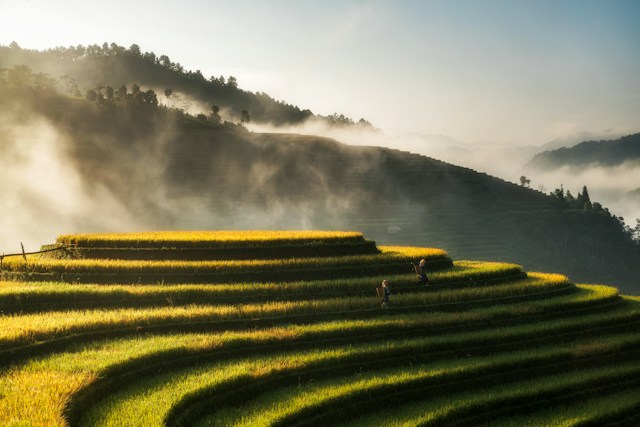
- September and October: the terraced rice fields of Sapa, Mu Cang Chai and Hoang Su Phi turn golden. This is the north’s signature postcard view.
- October and November: buckwheat flowers bloom in Ha Giang, ideal for riding the famous Ha Giang Loop by motorbike or with a driver.
- November: yellow and red leaves in Hanoi and a crisp atmosphere perfect for strolling the Old Quarter.
If you can only make one trip to the north, September to November is the safest bet. Just book in advance, because it’s high season.
Winter in the North (December to February)
This is the coldest time of year. In Hanoi, temperatures hover between 10 and 17 °C (50–63 °F), with cloudy days and high humidity. In Sapa, nights can drop close to 0 °C (32 °F) and, on rare occasions, it snows at higher elevations, which draws many domestic visitors.
Things to keep in mind:
- Fog can hide the mountain views in Sapa.
- In Ha Long Bay, February is often misty and humid, with moody landscapes but limited visibility.
- You’ll need a warm jacket, layers and closed-toe shoes.
If you don’t mind the cold, it’s a quiet season with fewer tourists, and a good time to experience Tet culture in the cities.
Summary: Best Time to Visit Northern Vietnam
Best months: September, October, November, March and April. Avoid if possible: July and August (typhoons and extreme heat), and January if you don’t tolerate cold well.
Best Time to Visit Central Vietnam (Hue, Da Nang, Hoi An, Phong Nha)
Central Vietnam has a different climate pattern from the rest of the country: the dry season runs from February to August and the rainy season from September to December.
Dry Season (February to August)
This is the best time to visit central Vietnam. Skies are blue, the sea is calm and the beaches of Da Nang, Hoi An and My Khe are at their best.
- February to May: temperatures are comfortable, 22 to 32 °C (72–90 °F), and humidity is lower. If you’re looking for a single ideal period, this is it.
- June to August: it gets quite hot, 33 to 38 °C (91–100 °F) with a high heat index, but it’s also the best time for the beach. It’s peak season for domestic tourism, so prices go up.
Rainy and Typhoon Season (September to December)
This is the trickiest part of the year. October and November bring the heaviest rain, and flooding is common, especially in Hoi An, where the Ancient Town can be partially underwater. Typhoons can also hit Da Nang and Hue.
If you travel during this period anyway:
- Check the forecast frequently.
- Buy travel insurance that covers cancellations.
- Leave buffer days in your itinerary.
Phong Nha and the Caves
The best time to visit Phong Nha-Ke Bang and its caves, such as Paradise Cave and Phong Nha Cave, is March to August. During the rainy season, river levels rise and some caves and tours may close.
Hue and the Imperial City
Hue is rainier than Da Nang. From January to April you may get drizzle, but temperatures are pleasant. May to July is the best window to visit the royal tombs and the Citadel without constant rain, though it is very hot.
Summary: Best Time to Visit Central Vietnam
Best months: February, March, April, May and June. Avoid if possible: October and November.
Best Time to Visit Southern Vietnam (Ho Chi Minh City, Mekong Delta, Phu Quoc, Con Dao)
The south has a tropical climate with only two seasons: dry and rainy. Temperatures stay high all year, between 25 and 35 °C (77–95 °F).
Dry Season (November to April)
This is the best time to visit the south. There is less humidity, clear skies and calm seas. December, January and February are the most pleasant months, though with more tourists and higher prices. March and April are very hot, with peaks of 35 °C (95 °F) or more.
- Ho Chi Minh City: explore on foot, by motorbike or on a food tour without rain interruptions.
- Mekong Delta: the Cai Rang and Cai Be floating markets are comfortable to visit.
- Phu Quoc: the beaches are at their best, with calm water and good diving.
Rainy Season (May to October)
Rain is usually heavy but short, often in the afternoon, and rarely ruins a whole day. It’s a greener season with fewer tourists and better prices. Even so, in Phu Quoc the sea can be rough and some boat trips get cancelled, especially between July and October.
In the Mekong Delta, the flood season arrives from September to November, with lush green scenery and full canals, though the heat is humid.
Summary: Best Time to Visit Southern Vietnam
Best months: December to March. Avoid if possible: August, September and October if you want a beach holiday in Phu Quoc.
Best Time to Visit Da Lat and the Central Highlands
Da Lat has a mild mountain climate year-round, with temperatures between 15 and 25 °C (59–77 °F). It’s an ideal escape from the heat of the south.
- November to April: dry season. Wild sunflowers bloom in November and December, and local cherry blossoms in January and February.
- May to October: rainy season, with afternoon downpours but very green scenery.
The best time to visit Da Lat is from November to March.
Best Time for Vietnam’s Beaches
If the beach is your main goal, here are the reference points:
- Phu Quoc, Con Dao and Mui Ne: November to April. Mui Ne is also a kitesurfing paradise during this period thanks to steady winds.
- Da Nang and Hoi An (An Bang): February to August.
- Nha Trang and Quy Nhon: January to September, with rain concentrated toward the end of the year.
In other words, there’s good beach weather somewhere in Vietnam almost all year, as long as you pick the right coast.
Vietnam Weather by Month: Quick Overview
| Month | North | Central | South |
|---|---|---|---|
| January | Cold and cloudy | Cool, drizzly | Excellent |
| February | Cold, drizzle | Very good | Excellent |
| March | Very good | Excellent | Excellent |
| April | Excellent | Excellent | Intense heat |
| May | Hot, green rice fields | Excellent | Rains begin |
| June | Hot and rainy | Very good, hot | Rainy |
| July | Rain and typhoons | Very good, hot | Rainy |
| August | Rain and typhoons | Good, hot | Rainy |
| September | Very good, golden rice | Rains begin | Rainy |
| October | Excellent | Heavy rain | Rainy |
| November | Excellent | Rain and flooding | Improving, good weather |
| December | Cold | Rainy, improving | Excellent |
Festivals and Events That Affect When You Should Go
Beyond the weather, consider the festival calendar, which affects prices, transportation and availability.
Tet (Lunar New Year)
The country’s biggest holiday falls between late January and mid-February. In 2027, it is celebrated in early February. During Tet week, many shops and restaurants close, transport is overloaded and prices go up. On the other hand, it’s an intense cultural experience, with flowers, parades and decorations everywhere. If you want to travel during these dates, book far in advance and plan fewer transfers.
Mid-Autumn Festival (Tet Trung Thu)
Held in September or October, with lanterns, mooncakes and lion dances, especially in Hanoi and Hoi An.
Hoi An Lantern Festival
Held on the full moon night of every month, when the Ancient Town is lit with colorful lanterns. Keep in mind that flooding can occur during the rainy season.
National Holidays
April 30, May 1 and September 2 are public holidays, so beach destinations and roads fill up with domestic tourists.
High, Shoulder and Low Season: How to Save Money in Vietnam
- High season: December to February, and September to November in the north. Hotel and cruise prices rise and you need to book months ahead.
- Shoulder season: March, April and May. This is probably the best balance of weather, price and crowds.
- Low season: June to August in the north and south. There are significant discounts, but the weather is less predictable.
If you want to optimize your budget without sacrificing too much on weather, aim for March, April or early May.
Sample Vietnam Itineraries by Season
If You Travel in Spring (March to May)
Classic north-to-south route: Hanoi, Ha Long or Lan Ha Bay, Ninh Binh, Hue, Hoi An, Da Lat and Ho Chi Minh City with the Mekong Delta. This is the window that works best for covering the whole country.
If You Travel in Summer (June to August)
Focus on central Vietnam: Da Nang, Hoi An, Hue and Phong Nha, with beach days. Avoid the far north and the south if you don’t tolerate rain well.
If You Travel in Fall (September to November)
Prioritize the north: Hanoi, Ha Giang, Sapa, Mu Cang Chai and Ninh Binh. If you want to add the south in November, Ho Chi Minh City and the Mekong work well.
If You Travel in Winter (December to February)
Concentrate on the south and the Highlands: Ho Chi Minh City, the Mekong, Da Lat and Phu Quoc. If you go north, bring warm clothes.
Practical Tips for Traveling to Vietnam by Season
- Check the forecast before booking domestic flights. Typhoon delays are common on the central coast.
- Get travel insurance that covers cancellations and weather conditions.
- Dress in layers. Even in summer, buses and hotels have very strong air conditioning.
- Bring a light rain jacket instead of an umbrella in mountain areas.
- Protect your devices with a waterproof case if you travel in the rainy season.
- Book Ha Long and Lan Ha Bay cruises with flexible cancellation, since departures can be suspended due to bad weather.
- Check visa or e-visa requirements in advance, as policies can change.
Vietnam Travel FAQ: When Should You Go?
What is the best month to visit Vietnam?
March and April are probably the best months for a trip combining north, central and south. If you’re only visiting the north, September to November is the ideal period.
What is the worst time to visit Vietnam?
It depends on the region. In the north, July and August because of heat and typhoons. In central Vietnam, October and November because of heavy rain and flooding. In the south, August to October for the most persistent rain.
When is the rainy season in Vietnam?
In the north and south, May to October. In central Vietnam, September to December.
When is typhoon season in Vietnam?
Mainly July to November, with the greatest impact in the north between July and September and on the central coast between September and November.
What is the best time to visit Sapa?
September and October for the golden rice terraces, and March to May for pleasant weather. Winter is very cold and often foggy.
What is the best time to visit Hoi An?
February to May. During these months the weather is warm, rainfall is low and there is no flood risk.
What is the best time to visit Phu Quoc?
November to April, with calm seas and clear skies.
What is the best time to visit Ha Long Bay?
October to April, with better visibility and a lower risk of typhoons, although February and March can bring fog and drizzle.
How many days do you need to see Vietnam?
For a full north-to-south route, 14 to 21 days is recommended. With 10 days you can cover two regions without rushing.
Is it safe to travel to Vietnam in the rainy season?
Generally yes, as long as you keep an eye on local weather alerts and stay flexible. Rain in the south tends to be brief, while rain in central Vietnam can be more disruptive.
Conclusion: When Is the Best Time to Go to Vietnam?
There is no single answer, but there is a clear strategy: choose the region with the best weather for your travel dates.
- Want culture, mountains and rice terraces? Go north in fall or spring.
- Want beaches, history and food? Go central between February and June.
- Want sun, the delta and tropical beaches? Go south between December and March.
- Want to see the whole country? Go in March or April.
If you plan with the weather in mind, Vietnam will surprise you in any month of the year. And remember that forecasts can vary from year to year, so check current conditions before booking flights and accommodation.
Ready to build your itinerary? Pick your region, set your dates and start booking early, especially if you’re traveling in high season.

También te puede interesar

T-Money o Climate Card: viajar a Corea 2025

Traveling to Vietnam: Everything You Need to Know